Relationships

Researchers consider healthy relationships to be the single most important factor in happiness.

“People with strong and broad social relationships are happier, healthier and live longer. Close relationships with family and friends provide love, meaning, support and increase our feelings of self worth. Broader networks bring a sense of belonging. So taking action to strengthen our relationships and build connections is essential for happiness”. 

Our connections with other people are at the heart of happiness – theirs and ours. Whether these connections are with our partners, families, friends, work colleagues, neighbours or people in our broader communities, they all contribute to our happiness. Chris Peterson, one of the founders of positive psychology puts it simply as: “Other people matter”.

https://www.actionforhappiness.org/10-keys-to-happier-living/connect-with-people/details

Martin Seligman who created the PERMA framework for wellbeing rates relationships as one of the keys to wellbeing too.

This week we can reflect on the qualities of (or what makes) a good friend and why our friends are important to us. We can think of the ways we connect with our friends.

Within our BHPS positive statements, Relationships means;  “I can accept, understand and empathise with others”.

We created this video in 2021. (back in the times we had lockdowns!) It is about the ways in which we can nurture our relationships, both during Covid and now. Hope you enjoy watching it!

People who are good friends recognise and understand the emotions of others so that they can figure out how others are feeling. Research has shown that empathy (noticing what other people are feeling) is associated with children who are smarter, nicer, happier and more resilient. Have you reached out to someone who may not be feeling great?

There are many great ways to connect and I bet you can all remember this song by The Wiggles!

Rose Meets Mr Wintergarden is another book about empathy and making connections and being kind.

Stick and Stone

The Little Book of Friendship

Some ideas for connecting include:

Catching up with with family and friends or talking via phone, Facetime or Zoom. You could even do an activity together such as baking or making something.

Write handwritten cards or notes to family and friends. These could be posted or dropped off in people’s mailboxes. Everyone loves receiving these! You could also send messages via text or email.

There are so many examples of people connecting and being kind to friends, family and others in our community. We would love to hear about how you connect – feel free to share on this blog x


Engagement

At Barwon Heads PS we define Engagement as making the most of learning opportunities. Engagement is the second arm of our PERMA model. This can mean tuning in to instruction and tasks and focussing on schoolwork. Being engaged can also means achieving a state of “flow”. This can happen when doing many activities including maths, playing sport, reading, writing and drawing/painting.

Ways in which students are engaged at school include:

Being enthusiastic towards learning

Tuning in to instruction and tasks

Using the Learning Focus and Success Criteria

Making the most of conferencing time with teachers

Focussing on school-work

Following class and school rules

Thinking before acing or speaking

Acting with self-control in the classroom and in the yard.

Turn and talk to a partner –

Which things on this list do you do best? Which things on this list would you like to do better at?

Some tips and ideas on Engagement

More about Flow

The Boy How Loved Words – How does Felix’s love of words connect to “Engagement”?

The Girl Who Thought In Pictures

Ada Twist Scientist – A very engaged young lady!

The Dot

Positive Emotions

This image has an empty alt attribute; its file name is s-b-vonlanthen-FaiZNiofP-U-unsplash-1024x684.jpg

This week our focus will not be on a character strength, but on the “P” of our PERMA model. P is for Positive Emotions and there are quite a few Character Strengths that can be associated with Positive Emotions. Learning about emotions, both positive and not so positive, helps expand our wellbeing literacy.

“Wellbeing literacy is defined as a capability to comprehend and compose wellbeing language, across contexts, with the intention of using such language to maintain or improve the wellbeing of oneself, or others or the world.” (Oades, Jarden, Hou, Ozturk, Williams, Slemp & Huang, 2021)

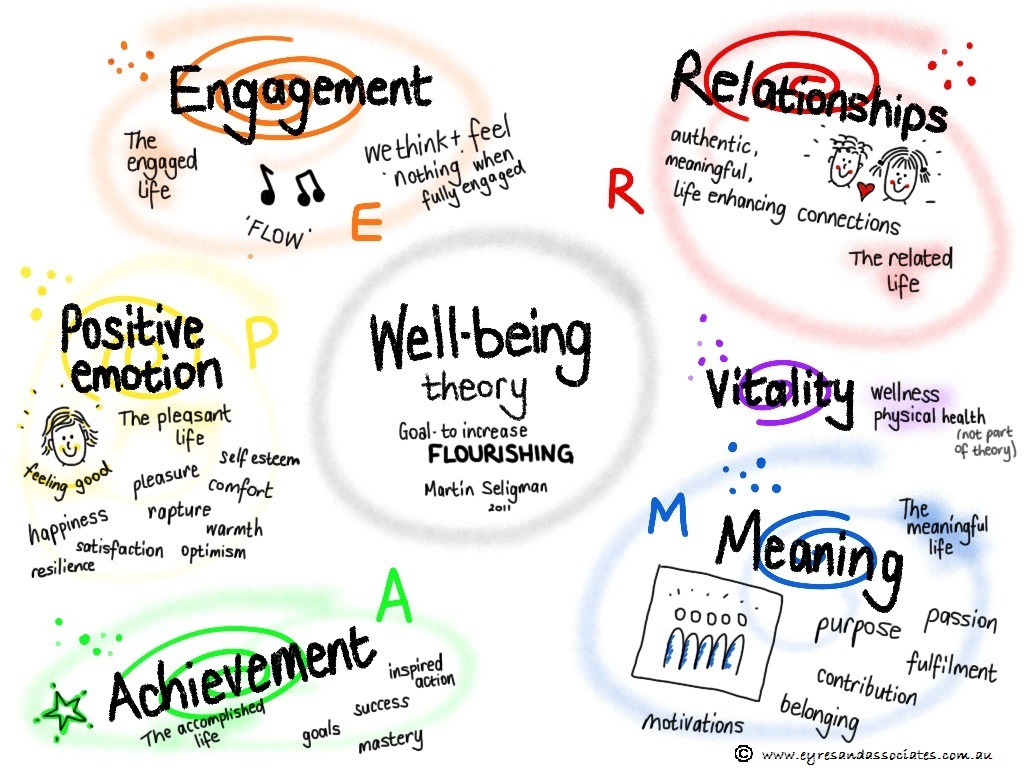
Positive psychologist Professor Martin Seligman has spent many years researching ‘happiness’. Positive Psychology suggests that happiness is the natural result of building up our well-being and satisfaction with life. His studies have helped him identify 5 building blocks of well-being. Each of these elements is essential to our well-being and satisfaction with life. Together, they form the solid foundation upon which we can build a happy and flourishing life.

He calls his model the PERMA model and this is the model that we use at Barwon Heads PS :

  • P – positive emotion
  • E – engagement
  • R – relationships
  • M – meaning
  • A – achievement (accomplishment)
Flourish model - PERMA plus vitality

Thanks to “Discovery in Action” for these words and infographic.

This week we focus on Positive Emotions

Positive emotion is more than just ‘happiness’. There are a range of positive emotions, including amusement, hope, interest, joy, love, compassion, gratitude, and pride. Part of our capacity for experiencing positive
emotions is genetic, but all of us have the ability to purposefully experience more positive emotion.

You can build positive emotion by:
• Taking time to find things you are grateful for in your life and reflect on what is going well and how you have contributed to those situations.
• Spending time with people that you care about
• Doing activities that you enjoy, such as hobbies or pastimes
• Play with your family members, your pets or your friends
• Listening to uplifting music that you love
• Exercising. It can help raise your levels of positive emotions, as well as keep you healthy
Having an attitude of optimism which is critical to building resilience.

Positive Emotions (1.20)

Barbara Fredrickson has led much of the research into Positive Emotions. This is a 5 minute interview with her where she explains her findings and that of other positive psychology scientists.

The Happy Owls read aloud

Proactive Mental Health – PERMA (2.25)